A TOEFL 2026 academic passage is roughly 200 words with up to five multiple-choice questions attached.1College CouncilTOEFL 2026 Reading: Complete the Words, Read in Daily Life, and Academic PassageOpen source ↗Jump to footnote2TestSucceedTOEFL 2026 Reading Task 3: Read an Academic PassageOpen source ↗Jump to footnote The old test gave you 600 to 700 words and ten questions.3TOEFLairTOEFL 2026: What Changed in Every Section (Before vs After)Open source ↗Jump to footnote Most returning test-takers hear that and relax. Then they score lower on Reading than they did in 2019.
The reason is density. Five questions on 200 words means almost every sentence in the passage is doing work that something asks about, and the question stem (the part that asks the question, above the four answer choices) no longer tells you which paragraph to look in, which was the habit the old section trained.4PrepDrillsTOEFL Reading 2026: Question Types, Timing, PracticeOpen source ↗Jump to footnote Skim-and-hunt was a perfectly good strategy on a 700-word passage that pointed you to a paragraph. On 200 words it wastes the time it was invented to save.
What replaces it is a four-minute routine built on a single full read, and the rest of this page walks through it. For the whole-exam picture, start with the TOEFL 2026 test format guide.
What you see on test day
Reading is the first section of the 2026 test.5ETS OfficialTOEFL iBT Test Content: A Breakdown of Test SectionsOpen source ↗Jump to footnote ETS lists it at about 30 minutes for roughly 50 items, with the caveat that "as the test adapts, test time and items may vary."5ETS OfficialTOEFL iBT Test Content: A Breakdown of Test SectionsOpen source ↗Jump to footnote Prep breakdowns usually report a lower range, 35 to 48 scored items in something closer to 20 to 27 minutes, because the routing path changes how many items you see.4PrepDrillsTOEFL Reading 2026: Question Types, Timing, PracticeOpen source ↗Jump to footnote1College CouncilTOEFL 2026 Reading: Complete the Words, Read in Daily Life, and Academic PassageOpen source ↗Jump to footnote Plan against ETS's figures.
Reading runs as two modules with separate timers.1College CouncilTOEFL 2026 Reading: Complete the Words, Read in Daily Life, and Academic PassageOpen source ↗Jump to footnote Everyone sees the same Module 1, and how accurately you answer it decides whether Module 2 is the harder version, which leans on academic content, or the easier one.4PrepDrillsTOEFL Reading 2026: Question Types, Timing, PracticeOpen source ↗Jump to footnote Only the harder Module 2 reaches the top of the band scale, and that harder module is also where the extra academic passages live, so the academic passage in Module 1 carries more weight than its five points suggest.4PrepDrillsTOEFL Reading 2026: Question Types, Timing, PracticeOpen source ↗Jump to footnote6ArnoTOEFL Read an Academic Passage: Complete Guide (TOEFL 2026 New Format)Open source ↗Jump to footnote Inside a module you can move between questions freely and change answers, but once you submit Module 1 you cannot go back to it.3TOEFLairTOEFL 2026: What Changed in Every Section (Before vs After)Open source ↗Jump to footnote1College CouncilTOEFL 2026 Reading: Complete the Words, Read in Daily Life, and Academic PassageOpen source ↗Jump to footnote
The academic passage itself appears on one side of the screen, with one question at a time beside it and four answer choices as radio buttons.2TestSucceedTOEFL 2026 Reading Task 3: Read an Academic PassageOpen source ↗Jump to footnote You can move backward within the task.2TestSucceedTOEFL 2026 Reading Task 3: Read an Academic PassageOpen source ↗Jump to footnote Vocabulary questions highlight the tested word in the passage. Nothing is highlighted for you on any other question type, and no stem names a paragraph.4PrepDrillsTOEFL Reading 2026: Question Types, Timing, PracticeOpen source ↗Jump to footnote
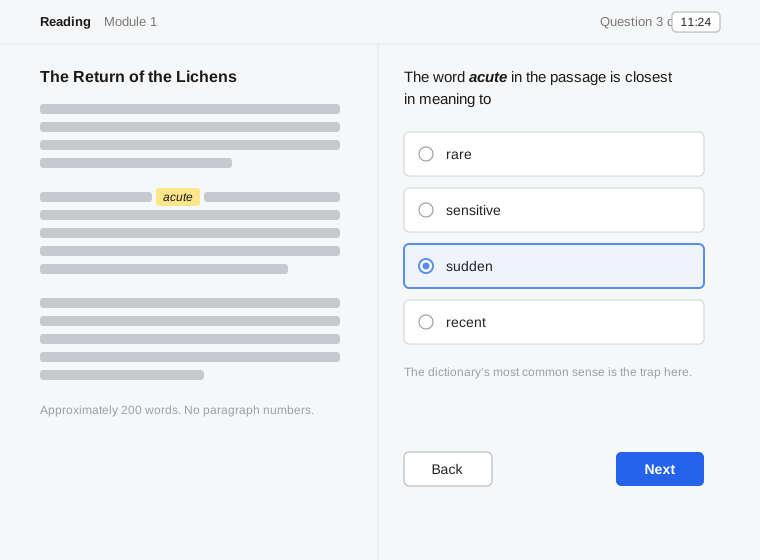
ETS describes the task as reading "a short academic passage similar to what you might see in a university course," with questions that measure comprehension of main ideas, supporting details, and vocabulary.7ETS OfficialTOEFL iBT Reading SectionOpen source ↗Jump to footnote Topics rotate through the natural sciences, history, social science, business, and the arts, and ETS is explicit that "all the information you need to answer the questions is included in the text."7ETS OfficialTOEFL iBT Reading SectionOpen source ↗Jump to footnote1College CouncilTOEFL 2026 Reading: Complete the Words, Read in Daily Life, and Academic PassageOpen source ↗Jump to footnote Passage difficulty spans roughly CEFR B1 to C2, which is part of how the adaptive routing separates bands.6ArnoTOEFL Read an Academic Passage: Complete Guide (TOEFL 2026 New Format)Open source ↗Jump to footnote
What Read an Academic Passage really tests
The skill under the surface is paraphrase detection. Almost every correct answer is a restatement of one or two sentences from the passage in different words, and almost every wrong answer is a sentence from the passage with one element changed: a stronger claim, a swapped cause and effect, a detail borrowed from the wrong paragraph.8TOEFL Mock TestsTOEFL Reading Question Types 2026: Complete Guide With ExamplesOpen source ↗Jump to footnote Your job on each item is to decide which of four restatements survives a check against the text.
The second skill is structural reading, which is what replaced paragraph-hunting. Because no stem points you to a location, you need a working map after one read: which paragraph introduces the thing, which one gives the mechanism, which one gives the complication. Readers who go for detail first lose time and then miss the main-idea question anyway.4PrepDrillsTOEFL Reading 2026: Question Types, Timing, PracticeOpen source ↗Jump to footnote
Nothing here rewards outside knowledge. A biology student reading a biology passage has no advantage, and a small disadvantage, because their background makes unsupported answer choices feel plausible.6ArnoTOEFL Read an Academic Passage: Complete Guide (TOEFL 2026 New Format)Open source ↗Jump to footnote
How Read an Academic Passage is scored
Every question is machine-scored, single-answer multiple choice, worth a maximum of one point, with no partial credit and no penalty for a wrong answer.6ArnoTOEFL Read an Academic Passage: Complete Guide (TOEFL 2026 New Format)Open source ↗Jump to footnote2TestSucceedTOEFL 2026 Reading Task 3: Read an Academic PassageOpen source ↗Jump to footnote A blank is worth exactly as much as a wrong guess, so an unanswered question is a wasted point.
Your raw correct count across all three Reading task types, together with the difficulty of the module you were routed into, becomes a Reading section score on the 1.0 to 6.0 band scale, reported in half-point increments and aligned to the CEFR.9ETS OfficialTOEFL Score Scale UpdateOpen source ↗Jump to footnote Your overall TOEFL score is "the average of the four section scores, rounded to the nearest half band."9ETS OfficialTOEFL Score Scale UpdateOpen source ↗Jump to footnote For two years after January 2026, score reports show your CEFR level, your 1 to 6 scores, and a comparable 0 to 120 overall score side by side.9ETS OfficialTOEFL Score Scale UpdateOpen source ↗Jump to footnote5ETS OfficialTOEFL iBT Test Content: A Breakdown of Test SectionsOpen source ↗Jump to footnote
Two things follow from that arithmetic. Because the routing module sets your difficulty ceiling, accuracy in Module 1 is worth more than accuracy in Module 2. And because the section score is a raw count with no weighting by question type, a vocabulary item you settle in twenty seconds is worth the same point as an inference item you agonize over for two minutes.6ArnoTOEFL Read an Academic Passage: Complete Guide (TOEFL 2026 New Format)Open source ↗Jump to footnote Spend your time accordingly.
The strategy, step by step
Read all 200 words once, at normal speed
Give it sixty to seventy-five seconds, start to finish, before you look at question 1. Do not skim, and do not stop to work out the hard noun in paragraph two. It is short enough to read once at full attention, and since no stem tells you which paragraph to check, that read is the only map you get.4PrepDrillsTOEFL Reading 2026: Question Types, Timing, PracticeOpen source ↗Jump to footnote
Label each paragraph with its job
As you finish each paragraph, name what it does in two or three words: "defines lichens," "how pollution kills them," "later use, plus a limit." You are summarizing function, not content. This takes about five seconds per paragraph, and it is what makes the going-back step fast later, because a stem asking why the author mentions something is answered by the label rather than by rereading.8TOEFL Mock TestsTOEFL Reading Question Types 2026: Complete Guide With ExamplesOpen source ↗Jump to footnote
Predict before you read the options
For factual, purpose, and inference questions, answer the question in your own words before looking at A through D. This single habit blocks most trap answers, because a wrong choice works by sounding reasonable on its own; it stops working once you already have a specific answer in mind and are matching against it.
Find the sentence, then commit
Before you click, point at the line that makes your choice correct. On factual questions there is always one, usually one or two consecutive sentences paraphrased.8TOEFL Mock TestsTOEFL Reading Question Types 2026: Complete Guide With ExamplesOpen source ↗Jump to footnote On inference questions there are two that combine. If you cannot find them, you are guessing, and guessing is better done by elimination than by feel.
Play each question type by its own rules
The test does not tell you which type you are looking at. There is no label on the screen, so you read the type off the wording of the question, and each one has a reliable tell:8TOEFL Mock TestsTOEFL Reading Question Types 2026: Complete Guide With ExamplesOpen source ↗Jump to footnote
- Factual information asks what the passage says, often with "According to the passage" or "The passage states that". It is the most common type, and the answer paraphrases one or two consecutive sentences. Watch for options that distort the paraphrase, overstate its scope, or are only half true.
- Negative factual puts NOT or EXCEPT in the question, usually in capitals. Mark each of the four options as supported or unsupported, and expect ninety seconds, since you are effectively answering four questions.
- Inference questions use wording like "It can be inferred from the passage that", "The passage implies that", or "The author suggests that". They ask for a conclusion the passage leads to but never states directly, so if an answer choice repeats the passage almost word for word, it is wrong, because it needed no inference. The right choice follows from the text but goes only one small step beyond it. Two traps show up again and again: a choice that goes further than the passage supports (making the claim bigger or more certain than the text does), and a choice that gets a relationship backwards (the passage says one thing causes another, and the choice swaps them).
- Vocabulary in context is the easiest to spot: one word in the passage is highlighted, and the question reads "The word X in the passage is closest in meaning to". It asks for the meaning as used here, which is often not the word's most common meaning. Substitute each option into the original sentence and reread it.
- Paragraph relationship questions ask "Why does the author mention", or say a paragraph "serves to" do something. They ask what a paragraph does rather than what it says: contrast, example, elaboration, cause, qualification, problem and solution. Your job labels answer these directly.
- Main idea and purpose questions ask "What is the passage mainly about" or "The author's main purpose is". The answer has to cover the whole passage; wrong options are usually true statements pulled from one paragraph.
Budget four minutes, and leave the hard one
Four to five minutes per academic passage keeps you on pace for the module.2TestSucceedTOEFL 2026 Reading Task 3: Read an Academic PassageOpen source ↗Jump to footnote If one question passes ninety seconds, eliminate what you can, pick the survivor, and move; you can return to it within the module if time allows.3TOEFLairTOEFL 2026: What Changed in Every Section (Before vs After)Open source ↗Jump to footnote Sitting on it costs points elsewhere in a section that gives you roughly 30 minutes for 50 items.5ETS OfficialTOEFL iBT Test Content: A Breakdown of Test SectionsOpen source ↗Jump to footnote
Common mistakes on academic passages
Skimming first, reading second. This is the most expensive habit carried over from the old test, where paragraph references in the stems made hunting efficient.4PrepDrillsTOEFL Reading 2026: Question Types, Timing, PracticeOpen source ↗Jump to footnote On 200 words, skimming means reading the passage two or three times in fragments instead of once in full.
Answering from what is true rather than from what is written. ETS says everything needed is in the text.7ETS OfficialTOEFL iBT Reading SectionOpen source ↗Jump to footnote The corollary is that everything not in the text is disqualified, however accurate it is. When two options both look right, the tiebreaker is always which one you can underline.
Choosing a stated fact on an inference question. If the option appears in the passage almost word for word, no inference was required, so it is not the answer to an inference stem.8TOEFL Mock TestsTOEFL Reading Question Types 2026: Complete Guide With ExamplesOpen source ↗Jump to footnote This trap catches strong readers most often, because the stated option is genuinely true.
Using the dictionary meaning on vocabulary questions. These items ask what the word means as used in this sentence.8TOEFL Mock TestsTOEFL Reading Question Types 2026: Complete Guide With ExamplesOpen source ↗Jump to footnote The word's most common sense is usually sitting there as a distractor. Substitution is the fix: put the option in the sentence and see whether the sentence still says what it said.
Rereading from the top for every question. If you labeled the paragraphs, you already know where to go. Restarting at sentence one on each of five questions means reading the passage five times.
Burning Module 1 time on one hard item. Module 1 accuracy determines whether you ever see the harder Module 2, and therefore your score ceiling.4PrepDrillsTOEFL Reading 2026: Question Types, Timing, PracticeOpen source ↗Jump to footnote6ArnoTOEFL Read an Academic Passage: Complete Guide (TOEFL 2026 New Format)Open source ↗Jump to footnote Three minutes on a single inference question in the routing module is the worst trade available on the Reading section.
A worked example
Here is a passage of the length and register you should expect.
The Return of the Lichens
Lichens are not single organisms but partnerships between a fungus and an alga. The fungus supplies structure and holds moisture; the alga supplies food through photosynthesis. Because a lichen has no roots and no waxy outer layer, it takes water and minerals directly from the air touching its surface. Whatever that air carries, the lichen absorbs.
That dependence makes lichens acute indicators of air quality. Sulfur dioxide, the main pollutant released by burning coal, dissolves in the moisture on a lichen's surface and kills its algal partner. In nineteenth-century industrial cities the effect was pronounced enough that botanists were able to map "lichen deserts," zones several kilometers wide in which almost no species survived on tree bark or stone.
Those maps later became evidence. After European and North American governments limited sulfur emissions in the second half of the twentieth century, lichens reappeared in city centers, and records of which species returned first gave researchers an inexpensive measure of recovery. The method has limits. Lichens respond over years rather than weeks, and their decline shows that air quality has worsened without identifying which pollutant is responsible.
One read, about seventy seconds, and three job labels: what a lichen is and why it absorbs everything; how sulfur dioxide kills it, with the historical evidence; the later use of that fact, plus two limits.
The word acute in the passage is closest in meaning to (A) rare (B) sensitive (C) sudden (D) recent.
"Sudden" is the sense most learners have stored, from acute pain and acute illness, and it is the trap. Substitute it: "that dependence makes lichens sudden indicators of air quality" says nothing the paragraph supports. The sentence before it explains that lichens absorb whatever the air carries, so the paragraph is about responsiveness. B survives substitution and matches the surrounding logic.
Why does the author mention "lichen deserts"?
Do not reread the paragraph. Your label already says it: historical evidence for the killing mechanism. The correct option will read close to "to show the scale of the damage sulfur dioxide caused in industrial cities." The tempting wrong option describes lichen deserts as places where lichens never grew naturally, which flips the passage's point.
It can be inferred from the passage that a survey of lichen species in a city center could be used to (A) confirm that sulfur dioxide emissions have fallen (B) estimate how quickly a specific pollutant is rising (C) identify which pollutant is currently most harmful (D) measure long-term change in overall air quality.
Cross out C first: the passage says outright that the method cannot identify the responsible pollutant. B contradicts the sentence about lichens responding over years rather than weeks. A is the real temptation, since the passage does connect emission limits to the return of lichens, but it narrows the claim to one pollutant the method cannot isolate. D is the smallest defensible step, and two separate lines combine to support it, which is what an inference answer looks like.
How to study for TOEFL academic reading passages
The training target is reading a short, dense, unfamiliar text once and coming away with a usable structure. That is trainable in about fifteen minutes a day.
The daily read-and-label drill. Find one 200 to 300 word article a day: the summary section of a Wikipedia article, a research news item from a university press office, a short piece from a science magazine. Read it once at normal speed, close it, and write one short line per paragraph saying what that paragraph did. Ten minutes, including the check. Two weeks of this changes how you read under a timer more than question practice does, because it attacks the habit rather than the item.
The paraphrase drill. Take one sentence from whatever you read and rewrite the same claim in different words, keeping the strength of the claim identical. Then write a second version that is subtly wrong: overstate it, or flip the cause and effect. Five minutes a day, and it shows you how wrong answer choices are built, from the inside.
The vocabulary log, done right. Record the whole sentence you met a new word in, not the dictionary entry. Vocabulary in context items ask about the local sense of a word, so a log of isolated definitions trains the wrong thing.8TOEFL Mock TestsTOEFL Reading Question Types 2026: Complete Guide With ExamplesOpen source ↗Jump to footnote
A three-week outline that fits around other prep:
- Week 1: accuracy without a clock. One passage a day, no timer. For every question, right or wrong, say out loud which sentence proves the answer. Any question where you cannot do that counts as wrong even if you scored the point.
- Week 2: add the timer. Same volume at four minutes per passage including the read. Expect accuracy to drop for the first three sessions and recover by the end of the week, and keep the read-and-label drill running alongside it.
- Week 3 onward: sequence and fatigue. Do two or three passages back to back on a single running clock, so you practice arriving at passage three already tired, which is what the second Reading module feels like. Once a week, run the full Reading section in a mock test instead.
To self-evaluate, track two numbers: how many questions you got right, and how many you got right and could justify from the text. The gap between them is your real error rate, and it predicts your test-day score better than the raw count does.
How to practice this on FluentPrep AI
The Read an Academic Passage practice mode runs the task in test shape: the passage in its own panel, one question at a time beside it, four choices, and the tested word highlighted in the passage on vocabulary items. Press Check Answer and you get an immediate correct or incorrect plus an explanation that quotes the sentence the answer rests on, which is the evidence you should have found yourself. The library is organized into numbered tests, with Prev and Next moving you through the passages and a score for each completed test, and new passages are added regularly.
Get more out of it with one house rule: before you press Check Answer, say the supporting sentence out loud, then see whether the explanation names the line you named. When it names a different line, review that item even if you scored the point. Once a passage feels comfortable, run two or three in a row against a four-minute-per-passage timer, and mix in Read in Daily Life so you practice switching registers the way the real module makes you. All twelve tasks sit together on the practice hub.
Where to go from here
Tonight, take one 250-word article, read it once, and for each paragraph write a short phrase naming what it does, not what it says ("introduces the idea", "explains the cause", "gives a limit"), without looking back. Tomorrow, do one academic passage on FluentPrep AI with a four-minute timer and the point-at-the-sentence rule on every question. When four minutes stops feeling rushed, move on to Complete the Words, where most people quietly lose Module 1 points.
Footnotes
-
College Council. "TOEFL 2026 Reading: Complete the Words, Read in Daily Life, and Academic Passage". Accessed 2026-09-06. ↩ ↩2 ↩3 ↩4 ↩5
-
TestSucceed. "TOEFL 2026 Reading Task 3: Read an Academic Passage". Accessed 2026-09-06. ↩ ↩2 ↩3 ↩4 ↩5
-
TOEFLair. "TOEFL 2026: What Changed in Every Section (Before vs After)". Accessed 2026-09-06. ↩ ↩2 ↩3
-
PrepDrills. "TOEFL Reading 2026: Question Types, Timing, Practice". Accessed 2026-09-06. ↩ ↩2 ↩3 ↩4 ↩5 ↩6 ↩7 ↩8 ↩9
-
ETS Official. "TOEFL iBT Test Content: A Breakdown of Test Sections". Accessed 2026-09-06. ↩ ↩2 ↩3 ↩4
-
Arno. "TOEFL Read an Academic Passage: Complete Guide (TOEFL 2026 New Format)". Accessed 2026-09-06. ↩ ↩2 ↩3 ↩4 ↩5 ↩6
-
ETS Official. "TOEFL iBT Reading Section". Accessed 2026-09-06. ↩ ↩2 ↩3
-
TOEFL Mock Tests. "TOEFL Reading Question Types 2026: Complete Guide With Examples". Accessed 2026-09-06. ↩ ↩2 ↩3 ↩4 ↩5 ↩6 ↩7
-
ETS Official. "TOEFL Score Scale Update". Accessed 2026-09-06. ↩ ↩2 ↩3